Neo Mohsenvand — AI/ML Research Engineer and Product Designer

I’m a researcher, engineer, and designer. I like following a question from its mathematical foundations through experiments and working software, then building ways for other people to explore it.

My independent research includes new attention mechanisms, small language models that calculate with visual scratchpads, and a theory of imaging with gravity. I write papers, train models, and build the systems and interfaces that put those ideas to the test. I also make interactive books, artificial-life simulations, and visual experiments that let people explore mathematics, physics, and computation for themselves.

I’m Chief AI Architect for Global Finance at Caterpillar, where I design and build AI products, develop shared infrastructure, and teach engineers and leaders. Previously, I led wearable AI and brain–computer interface research at BrainCo and worked on machine learning for biosignals at Apple.

I earned my PhD at MIT, focusing on Human–AI Interaction, self-supervised learning, and interfaces for human memory and attention. Before MIT, I earned an MSc in Mathematical Modelling and Scientific Computing at Oxford.

Experience

  1. Chief AI Architect, Global FinanceJanuary 2026 – present · Irving, TX

    • Tempo: Designed and built a conversational investigation system with a meeting-like interview interface, combining stakeholder discovery, scheduling and OpenAI Realtime voice interviews with structured forms. Available to hundreds of internal users for idea intake, requirements gathering and conflict resolution.
    • Aperture: Designed and built a custom agentic image-generation harness that expands terse prompts and hundreds of references into slide decks and visual assets, reducing reliance on third-party subscriptions.
    • Touchless Invoice Processing agent: Co-developed end-to-end orchestration from email ingestion and scanned-invoice OCR through exception handling and Snowflake writes, with a detailed multi-level evaluation framework. Reduced invoices needing human review from 100% to 2%.
    • Teaching: Created 10+ workshop apps, including agentic RAG, talking dashboards and a voice-only data-science interface I designed. Teach engineers and senior leaders in the workshop's fifth iteration.
    • Developing shared infrastructure for AI application prototyping and deployment across Global Finance.

    Senior Principal Data Scientist, Global FinanceMay 2025 – January 2026 · Irving, TX

    • Penman: Built and deployed an enterprise financial-analysis system using SvelteKit and Azure to analyze earnings-call transcripts and regulatory filings for finance leaders.
    • Redesigned earnings-call transcript proofreading in Penman to help finance teams identify disclosure risks.
    • Built MLflow / DeepEval evaluation infrastructure and coordinated organization-wide benchmark development.
    • Built an AI-idea prioritization agent with RICE-derived scoring, internal impact metrics and human review.
    • Designed adversarial LLM analysis of draft financial disclosures.

    Senior Engineering Fellow, Artificial IntelligenceApril 2024 – May 2025 · Illinois

    • Founding technical hire of CAT Tech AI; led four engineers delivering 12+ applications for 8,000+ technical users through engineering-analysis automation.
    • Created Magic Table for million-row spreadsheet/database workflows, combining formulas and iterative local-LLM prompts to reduce cloud compute costs; developed versions with Ollama.
    • Built a ModernBERT-based embedding model for Caterpillar products and parts; orchestrated data collection, developed a synthetic training-pair generation app, and trained on an on-premises H200 cluster.
    • Led distributed training, data curation, SFT/PEFT, PPO/DPO alignment, and automated and human evaluation.
    • Established an AI curriculum and reading group across 10+ teams, training 300+ engineers.
    • Led 11 researchers developing wearable AI and brain-computer interfaces; named inventor on five provisional patent applications.
    • Led development of a conditional-GAN system reconstructing breathing patterns from 25 Hz wearable PPG. The published study reports a one-second breathing-curve feedback delay and respiratory-rate mean absolute error of 1.47 breaths/min across ten test subjects.
    • Led soft-speech interface research comparing contact and MEMS microphones. In an eleven-person study, contact microphones reduced soft-speech word error rate from 99–100% to 35% in the tested music/noise conditions.
    • Researched multimodal memory systems and physiological data, building on doctoral work in continuous-capture memory interfaces and self-supervised EEG representations.
    • Developed parameter-efficient transformers for biosignal event detection and continuous time-series processing.
    • Built methods to inspect attention heads and activation patterns in continuous time-series models.
    • Built a browser-based WebGL visualization engine for dynamic social-network graphs.
    • Developed a Python library for retrieving, composing, and visualizing Allen Brain Atlas connectivity data in 3D.

Education

    • Research in self-supervised learning and human–AI interaction.
    • Thesis: Classifying and Displaying Brain-Waves through Self-Supervised Learning. Advisor: Pattie Maes. Co-advisors: Tomaso Poggio and Ed Boyden.
    • First author of SeqCLR (ML4H NeurIPS Workshop, 2020), adapting contrastive learning to EEG through channel recombination and signal augmentations; evaluated emotion recognition, sleep staging, and abnormal-EEG detection across three datasets.
    • Doctoral work also included continuous-capture memory interfaces and tools for human attention.
    • Sparse-Signal Recovery and Compressive Sensing for Optical Functional Brain Imaging.
    • Advisor: Jared Tanner. Co-advisor: Mason Porter.
  1. Tehran Polytechnic2011 BSc Biomedical Engineering · BSc Electrical EngineeringPresident, IEEE Student Branch

Honours

  • NTT Data Fellowship — MIT, for Rhizome, a smart memory book
  • First place and AI Prize — MIT Grand Hack, for Memoroom, VR for Alzheimer’s
  • Bill Mitchell Design Award — MIT Media Lab
  • Khwarizmi Prize — first in mathematics and physics, and third the year before
  • Semifinalist — national mathematics and physics olympiads

Skills

Programming
Python, TypeScript, Embedded C, MATLAB, Mathematica, Lean, GLSL, WGSL
Machine learning
JAX, PyTorch, transformers, self-supervised learning, mechanistic interpretability
Training & alignment
FSDP, DeepSpeed, Ray; SFT, PEFT, LoRA, PPO / DPO, quantization
Evaluation
MLflow, DeepEval, benchmark design, automated and human evaluation
Agentic engineering
Harness engineering, LangGraph, RAG, tool orchestration, Claude Code, Codex
Realtime AI
OpenAI Realtime, ElevenLabs, Deepgram; low-latency multithreaded harnesses
Inference & serving
Ollama, Transformers.js, WebGPU, ONNX / WASM, vLLM
Data science
Time-series analysis, biosignal processing, feature extraction, scientific visualization
Cloud & data
Azure, AWS, Docker, progressive delivery, Snowflake, multimodal data pipelines
Design & UX
Adobe Creative Cloud, UX study design, Design Systems
Applications & UI
SvelteKit, React, Three.js / WebGL
Leading & teaching
AI system architecture · cross-functional R&D · curriculum design and workshops · mentoring · technical recruiting
Languages
English · Turkish · Persian · Mandarin

Projects

Research, tools, and things to learn by exploring.

40 projects across 8 fields

AI/ML Research

Attention mechanisms, certified neural computation, model compression, and probability sampling.

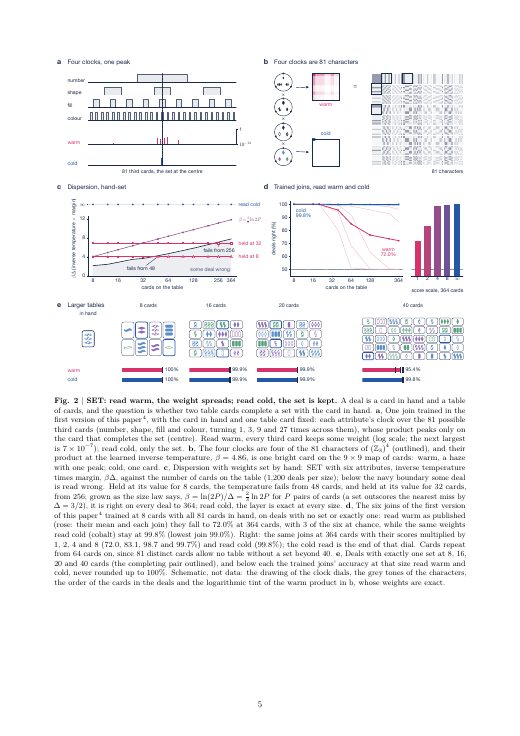
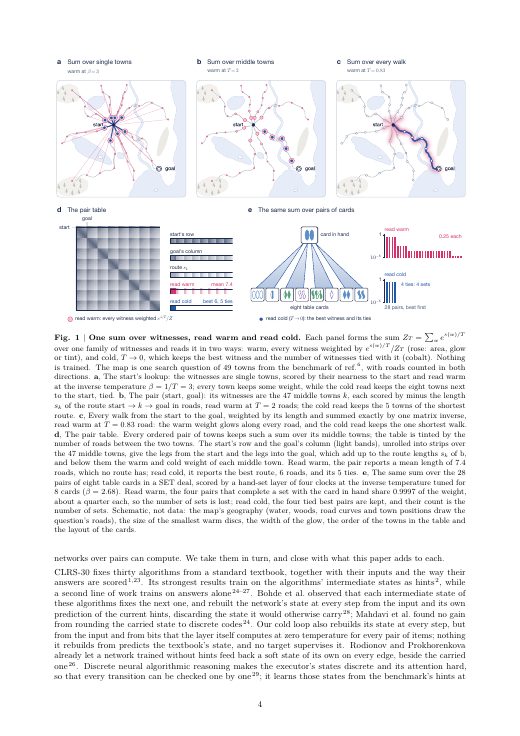
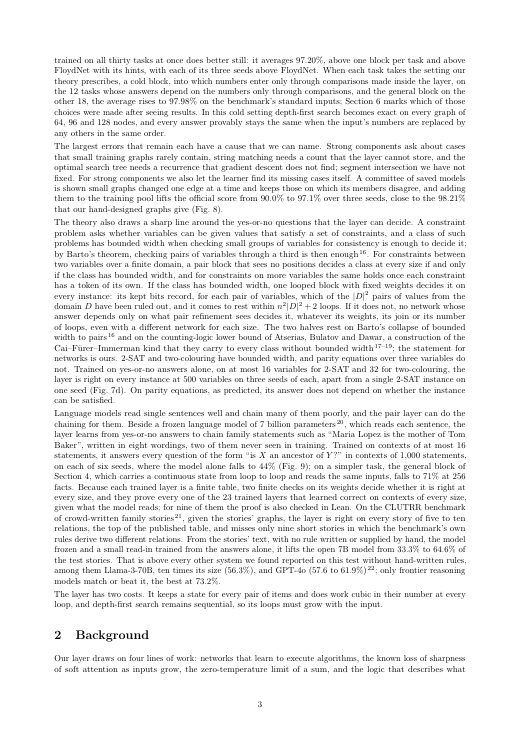
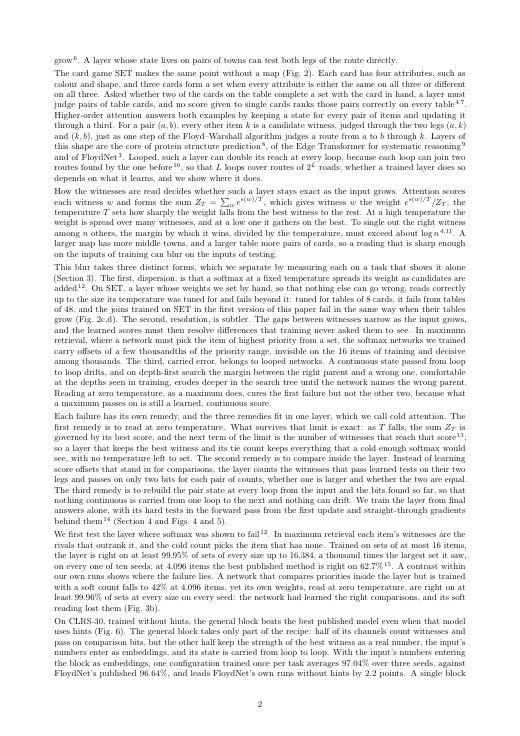
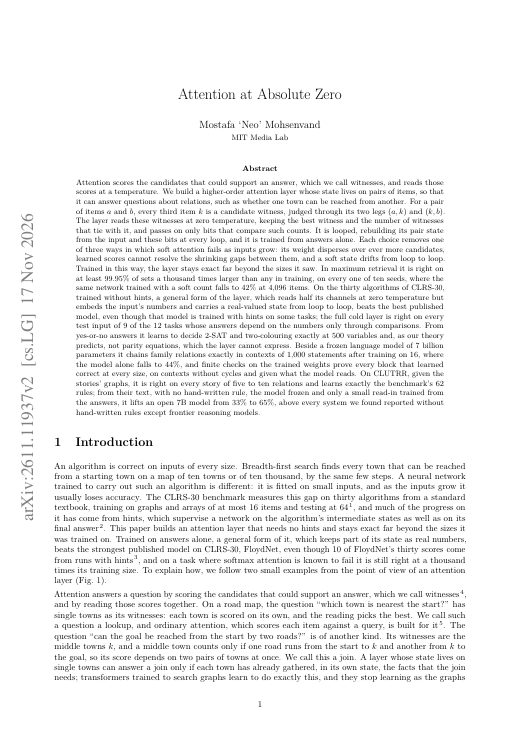
Introduced a higher-order attention mechanism that preserves how many candidates tie for the top score and reconstructs discrete state between reasoning steps. A shared general block averaged 97.2% across the 30-task CLRS benchmark at 64 items, after answer-only training on inputs of at most 16 items. Fully cold maximum retrieval reached at least 99.95% on sets up to 16,384 items across ten seeds. Finite checks also establish correctness of trained family-relation blocks at arbitrary context sizes for correctly encoded, acyclic inputs.

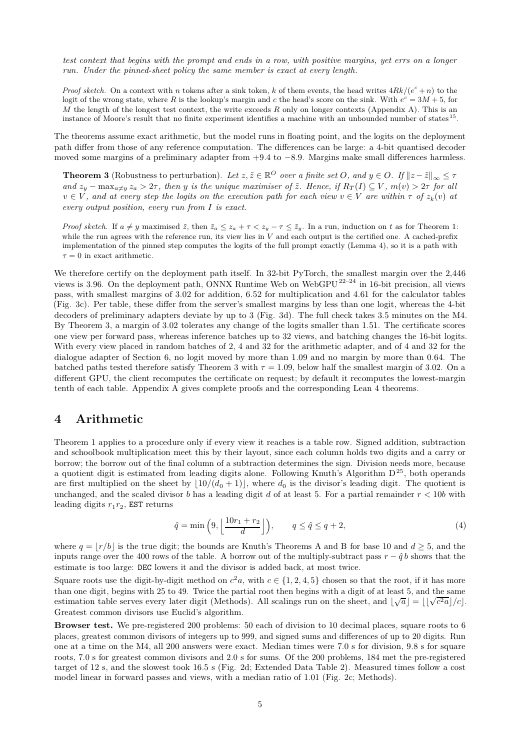
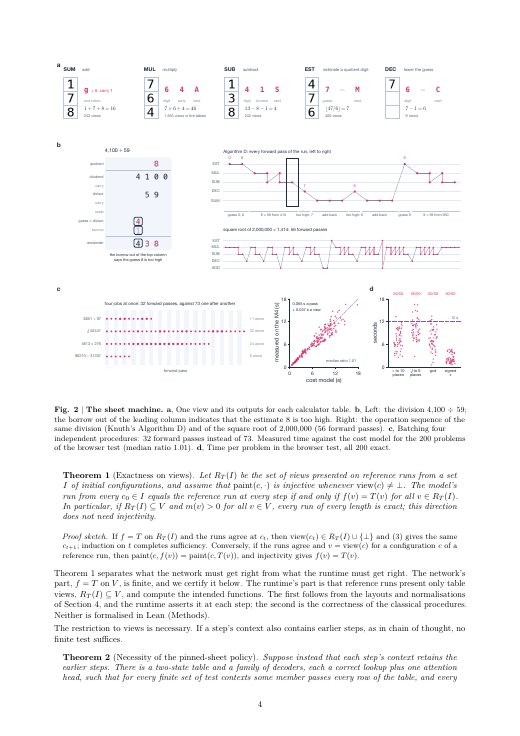
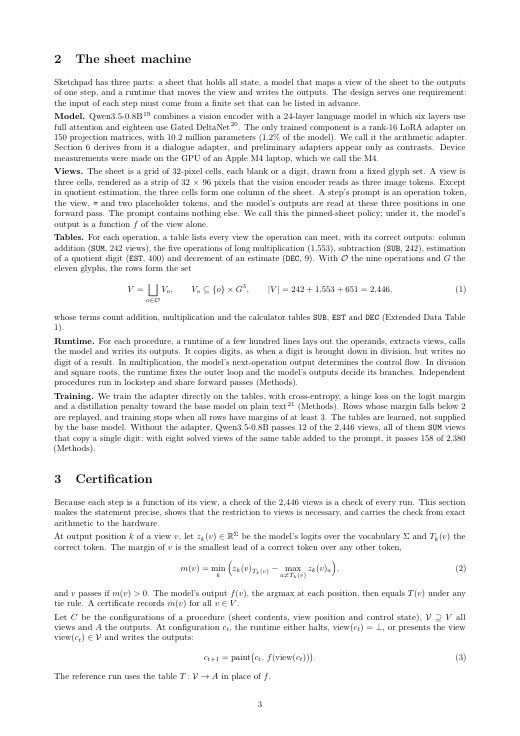
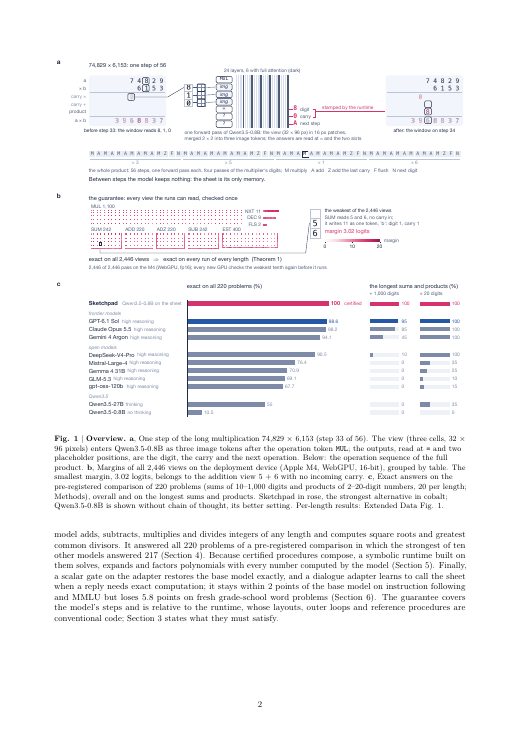
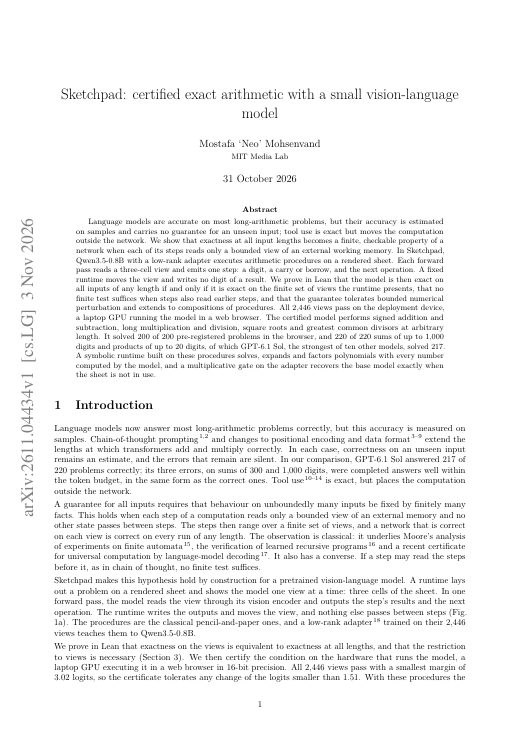
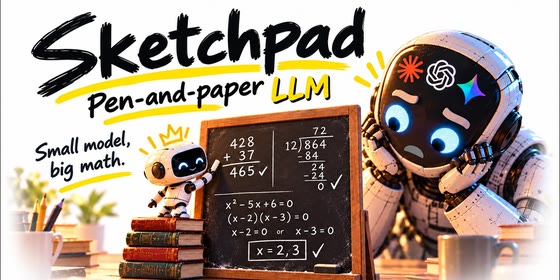
Trained a 0.8B-parameter vision-language model to perform exact arithmetic through a three-cell visual scratchpad; the model computes every output digit. Under explicit runtime assumptions, Lean-checked theorems reduce correctness at arbitrary input lengths to 2,446 local cases, all passed on an Apple M4 browser deployment. In a pre-registered server benchmark, it solved 220/220 addition and multiplication problems, including 1,000-digit sums; the strongest of ten comparison models solved 217/220. A separate browser evaluation passed 200/200 tests of division, roots, GCD, and signed arithmetic.

Built a WebGPU runtime that exposes the actual layer computations of a language model and a diffusion transformer. Using PrismML’s ternary models, trained a replacement text adapter, reduced the reader from 28 to 9 layers, and distilled one-, two-, and four-step image generation into a 1.2 GB download. The pipeline generates 512×512 images in about 4, 6, and 15 seconds respectively on an M4 MacBook Air in Chrome.

Designed and built a real-time probability-sampling game with a Gaussian kernel density estimate computed from each player’s samples. Shape error against a target distribution provides quantitative feedback on sampling strategy. Seeded targets, adaptive difficulty, and synchronized multiplayer matches make strategies directly comparable under a fixed time budget.

Physics Research

Mathematical results in gravitational imaging and interference geometry.

Developed an imaging theory for hypothetical detectors of gravitational tidal fields. Derived a quantitative logarithmic limit on near-field resolution and conditions under which one pixel can separate up to four overlapping gravitational waves over time, with fixed directions and independent waveforms. The work also treats thermal gravitational emission and imaging of moving masses, with a WebGPU simulator checked against an independent Python implementation.

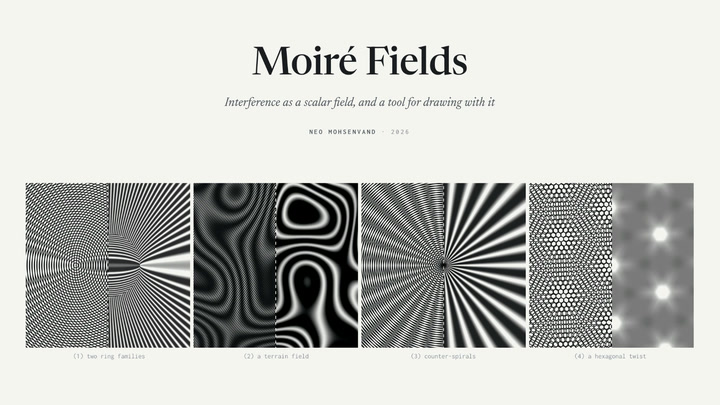
I developed the counting-map and distance-field theory behind this renderer and implemented it in WebGPU. The Moiré Fields paper below presents the theory. Its inversion algorithm bounds the search and skips provably irrelevant curve indices, running 10–35× faster than fixed enumeration in the tested rotated settings. Fourteen curve families and twelve simultaneous layers support live editing; a shader compiler automatically differentiates user-defined fields. The solver agrees with exhaustive evaluation wherever its certified search interval fits the execution budget.

Derived a local law for moiré fringes from differences between counting fields, with explicit validity conditions and an error bound. Continued fractions and lattice reduction identify dominant beats beyond a fixed harmonic-order cutoff; winding numbers determine the signed count of fringe endings at defects. Encoding a scalar field into two layers makes their interference draw its contour map, with a mean localization error of 0.80 pixels on the hardest tested field.

Artificial Life Research

Experiments and formal results on replication, heredity, and collective behavior.

Built a GPU artificial-life system in which self-replicating Z80 programs emerge from random bytes without an imposed fitness function. The associated study distinguishes reproduction from heredity: one early copier sustained lineages, yet none of 512 tested variants met the defined transmission criterion. Derived a conditional law linking copy displacement to heritable payload in overlapping copiers; all 1,067,608 tested Z80 cases matched its predictions.

Implemented metric-aware steering and area compensation for flocking on curved surfaces, including the torus, Möbius strip, and Klein bottle. A calibrated drift reduced the ratio between the most- and least-crowded regions from 5.7 to about 1.5 in the documented torus test. The WebGPU simulator supports seven interacting species and five neighbor-search strategies.

Built a reusable WebGPU cellular-automaton engine with square and hexagonal lattices, multistate rules, and configurable positive or negative influence from dying cells. Separated the rules and GPU runtime into framework-independent packages with a CPU fallback and an embeddable interface. Added real-time sonification that maps cell states to frequency spectra on the GPU and synthesizes the resulting audio.

Built a WebGPU batch emulator for artificial-life experiments across Z80, 6502, 8086, and BFF instruction sets, separating processor semantics from world rules and recording execution and memory writes. Validation covers more than seven million reference cases with zero unexpected differences under documented compatibility rules. The Z80 core executed 1.09 billion instruction steps per second in a warm GPU benchmark on an Apple M4, excluding host transfers.

Implemented Craig Reynolds’ flocking model with spatially partitioned neighbor queries and custom WebGL rendering, supporting thousands of agents in real time. Added live controls for the interaction rules and visual diagnostics for speed, orientation, and local density, with a Canvas2D fallback for devices without WebGL.

AI Engineering

Tools for building, inspecting, and working with AI systems.

Look inside a working AI agent as it runs: its plans, tools, memory, subagents, and context window. Recorded runs, request capture, replay, and persistent checkpoints make the surrounding harness available for inspection.

Read technical papers with an AI companion that explains equations and figures. Narration, scrolling, and highlighting stay synchronized as you explore PDF or Markdown documents with local or cloud models.

A practical, interactive course in AI engineering with 29 lessons on the LangChain stack. Work through the tools and concepts used to assemble language models into applications.

Compare twelve models on retrieval, classification, and clustering tasks. Explore their embeddings in 3D and inspect attention and tensors to connect model behavior with the representations underneath.

Turn selected regions of an image into text with vision language models. Give each region a prompt and watch the results stream in to explore how model instructions shape extraction.

An agent skill for building and training real neural networks in the browser with jax-js. It gives coding agents guidance for working with browser-based machine learning and GPU computation.

AI/ML Education

Learn by changing the experiment, training the model, and seeing what happens.

Explore gradient descent through live loss landscapes, optimizer races, and learning-rate controls. Guided lessons and curvature analysis connect the geometry you see with the way optimization algorithms learn.

An interactive deep-learning book with models that train on your own device. Follow the path from a single neuron to language models, diffusion, reinforcement learning, and visual world models.

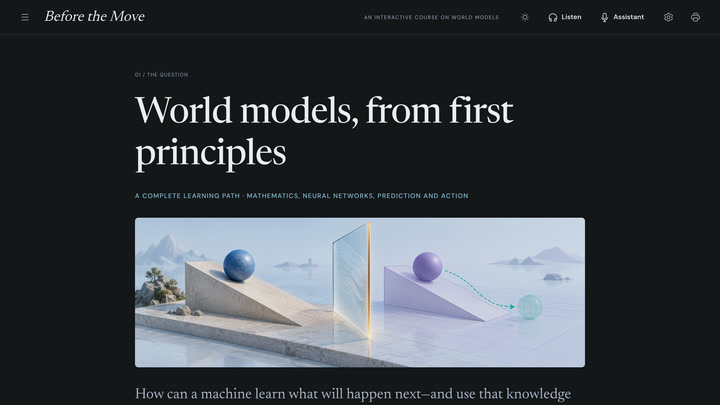
An interactive book on world models: how a system learns to imagine what happens next. Train a model in your browser, compare its predictions with reality, or discuss the text with a voice tutor.

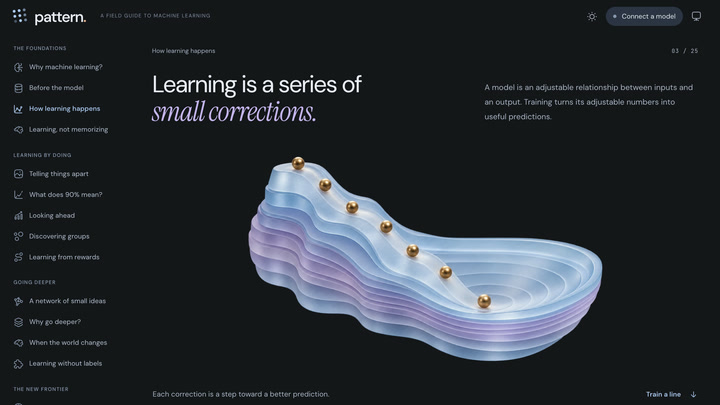
A visual introduction to machine learning, from fitting a line to running a tool-using agent. Follow real training experiments, inspect the data, and build intuition one interactive chapter at a time.

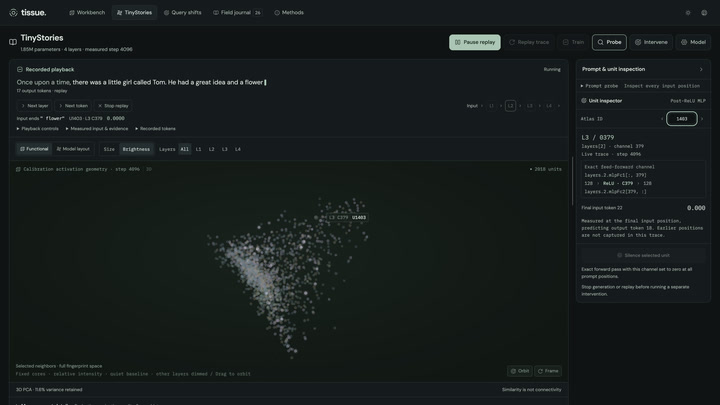
Train a small transformer in your browser, then inspect its measured activations in 3D. Follow generation token by token and intervene in the model to test how changes affect its behavior.

See how a model turns raw scores into probabilities. Adjust logits and temperature to explore how the softmax function changes the balance between confident and evenly distributed predictions.

Math and Physics

Interactive books and experiments that make abstract ideas tangible.

An interactive introduction to relativity, from a cart and a clock to curved spacetime. Change the experiments as you read, explore the geometry, or ask the page a question aloud.

Learn how mathematics counts holes and distinguishes shapes. Interactive 3D figures and a homology calculator connect the basic geometric ideas to the machinery of homology and cohomology.

An interactive calculus book built around local linearity. Move points and change parameters to connect derivatives, accumulation, gradients, and differential forms through a shared geometric picture.

Built an FFT-based numerical study that computes Goldbach partition counts for every even number through 20 million and measures agreement with the Hardy–Littlewood prediction. A second experiment detects the first five Riemann-zero frequencies in weighted cumulative counts; the first and fifth amplitudes agree within 1% with Fujii’s prediction under the Riemann hypothesis. A density-matched random-prime control lacks the same alignment.

Software Development

Visual guides, practical tools, and laboratories for understanding how software works.

A visual guide to Git for people building software with AI. Interactive explanations make repositories, changes, and collaboration easier to understand, so you can see what your tools are doing.

Learn to read, verify, and run shell commands with a visual guide and browser playground. Build the confidence to understand the commands an AI assistant suggests before using them.

An interactive atlas of 46 network protocols, from TCP to QUIC. Step through exchanges, inspect packet layouts and example code, and compare the mechanisms that let computers communicate.

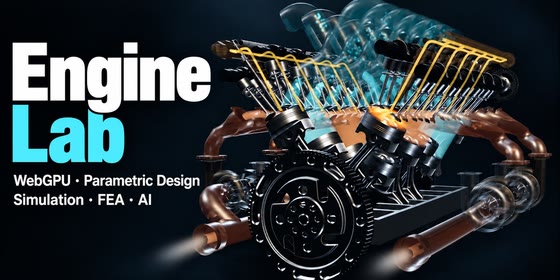
Take a V12 diesel engine apart in your browser and explore how its components fit together. Reshape parts and solve their stresses on the GPU to connect mechanical geometry with simulation.

Learn relational databases from first principles with live SQL playgrounds throughout the book. Read a concept, run a query, and inspect the result without leaving the page.

A native macOS tool for turning video clips into GIFs. Tune the conversion while previewing the actual encoded result, so you can judge quality and file size before exporting.

Record a browser tab with your microphone and a webcam overlay, then export a video or GIF. The recording workflow runs locally, making it useful for demonstrations, walkthroughs, and quick explanations.

A visual reference for interface components. Browse examples, compare different patterns, and copy what you need while learning the vocabulary for describing an interface to a coding assistant.

Music and Art

Playable instruments, visual worlds, and experiments at the meeting of sound and computation.

Learn music and MIDI through a playable instrument and hands-on lessons. Press a key to inspect the messages it sends, explore how sound is controlled, and test your understanding with practical checkpoints.

A playable browser replica of the OP-XY synthesizer paired with an AI guide. Learn its controls, create patterns and sounds, and explore an agent that can also interact with the physical instrument.

Chord

In progress

A playable instrument for exploring harmony through sound and geometry. Connected views of overtones, tuning, chords, and waveforms let you hear an interval and see the relationships behind it.

A real-time visual experiment that lets you fly through volumetric clouds and ocean waves. Explore an atmospheric world built from raymarched light, water, and procedural geometry.

Earlier work

inSight: Deep Neurofeedback Brain decoding using BigGAN and MusicVAE to generate naturalistic neurofeedback stimuli.
Affective Memory Summarization Using affective signals to condense 16 hours of body-cam footage into a 15-minute daily recap.
Large-Scale EEG Biometrics Self-supervised EEG-based user identification at scale, surpassing prior 157-subject limits.
Physiophone Sonification of electrophysiological signals — turning EEG, ECG, and EMG into sound.
Flower: EEG Visualization Open-source tool for in-depth visual analysis of multi-channel time-domain neural recordings.
SkipNorm A flexible deep learning building block that combines skip connections and normalization in one layer.
Q: Conversational Data Labeling An intelligent interface that builds a personal knowledge graph through natural conversation.
DataVRse VR visualization of the Twitter social graph during the 2016 U.S. Presidential Election.
Rhizome A tool for navigating personal memories to support people living with dementia.
The Electome AI-driven mapping of the 2016 election public sphere — where machine intelligence meets political journalism.
SeqCLR: Self-Supervised Features Contrastive learning of representations for EEG and other time-series data, without labels.
VR Maze in Zero Gravity Testing how spatial memory holds up on a parabolic flight, once the sense of up is gone.
The Foodome A knowledge graph of food, linking how we talk and learn about it to what it actually contains.
The Electome (Talk) A talk on the Electome from the Laboratory for Social Machines, built with Twitter and Knight Foundation.
Sole2Soul An interface with the soul of a city. First place and the Bill Mitchell Design Award at Make Me++.