Interactive figures
What a single pixel of the camera measures, from the paper’s Section VIII, as figures to explore. These are diagrams of the results, not views through the camera; each also appears under its figure in the online paper.

Principal null directions
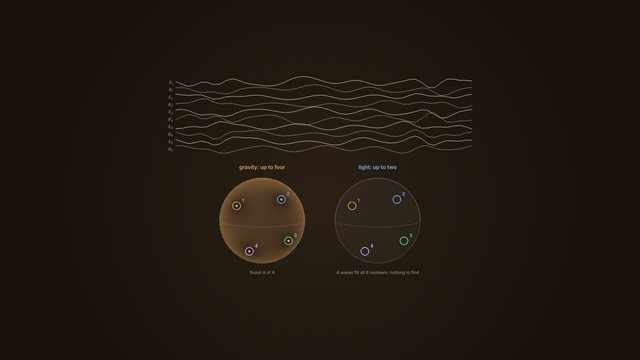
One point, four directions. Each reading of a gravitational pixel has four principal null directions; a reading of light has two. They tell one body from two, a wave from a pull, and how fast a body crosses the sky.
One pixel, four waves
Many waves at one point. Four waves cross one point, each with any waveform. One pixel of this camera finds where every one comes from; a sensor of light finds two.
Now and then
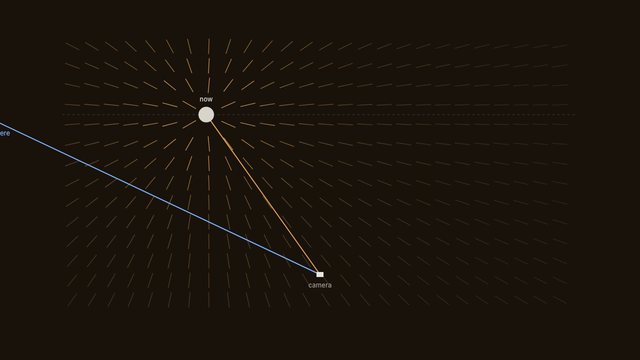
See the present. Light shows a moving body where it was; its tidal field points at where it is. Stop it, and the news spreads at the speed of light. Shown with light slowed down, and labelled so.
A pixel’s own velocity
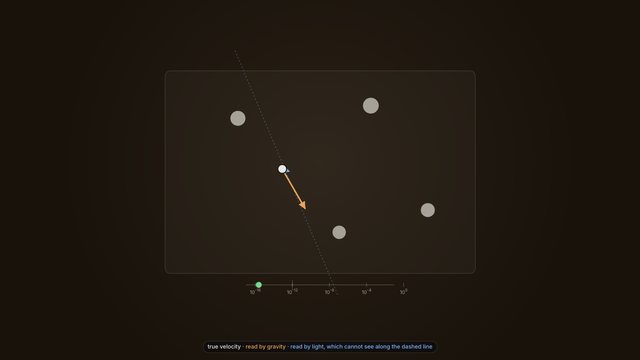
Own velocity, motion test. A pixel crossing a room of unknown masses determines its own velocity, every component, at any speed, from one reading. If its eigenvalues turn complex, something in the room moves. Light reads two components.
How far is that binary?
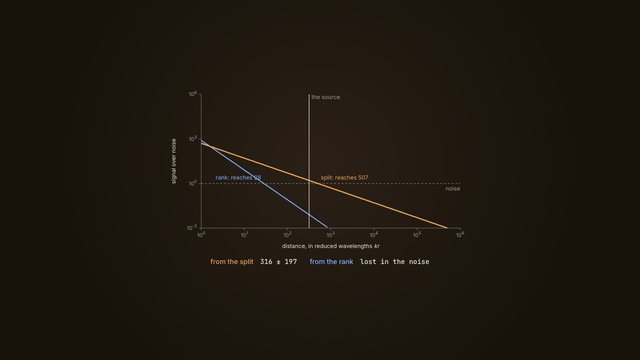
Range a wave source. The two senses of a binary’s waves arrive from directions that differ by an angle that shrinks with distance. One pixel reads it, out to a range set by the signal-to-noise ratio.
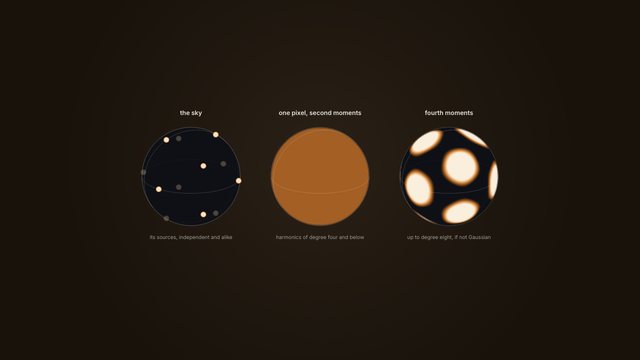
One pixel’s sky
What a point can know. A sky full of sources, seen by one pixel: exactly its patterns of degree four and below. Twelve sources on an icosahedron look like a uniform sky; six on an octahedron do not.
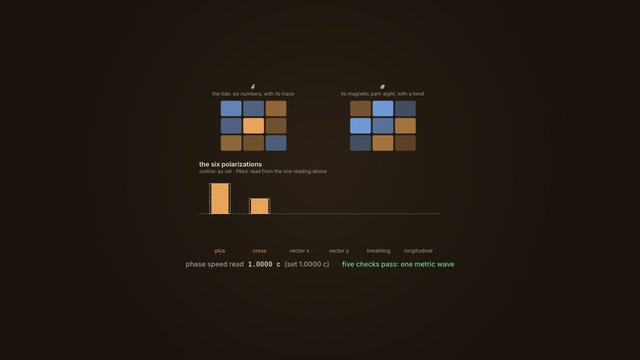
Beyond Einstein
Test gravity at a point. One reading gives a wave’s direction, its speed and all six polarizations a theory of gravity allows, and checks that they belong to one wave. A massive graviton and a scalar differ even in sign.